
Last Updated: November 4, 2026
Quick Summary
Plan a sushi making class for office teams by setting one clear goal, such as team bonding or a client event, and booking the corporate session early once your date and headcount are set. Then choose a format that fits your group, confirm logistics and dietary needs, and measure the result with same-day feedback.
- Decide whether the session is for team bonding, a reward, or a client-facing event before booking.
- Hands-on workshops suit small to mid teams, while guided demonstrations work for large or mixed-ability groups.
- Collect dietary and allergy requirements at the point of RSVP, not the week before.
- Allow one long table per group of roughly six to eight people for hands-on rolling.
- Send a short feedback form the same day and book a follow-up date while feedback is fresh.
Table of Contents
- Step 1: Set Your Goal and Book the Corporate Sushi Making Class Early
- Step 2: Choose a Sushi Team-Building Activity That Fits Your Group
- Step 3: Sort the Office Sushi Workshop Logistics and Dietary Needs
- Step 4: Run the Sushi-Making Class for Groups and Measure the Result
- Frequently Asked Questions
Step 1: Set Your Goal and Book the Corporate Sushi Making Class Early
Book a sushi making class for office teams with one clear goal and an early reservation.
Decide what the session must achieve: team bonding, a reward for a hard quarter, or a client-facing event. That answer shapes everything that follows.
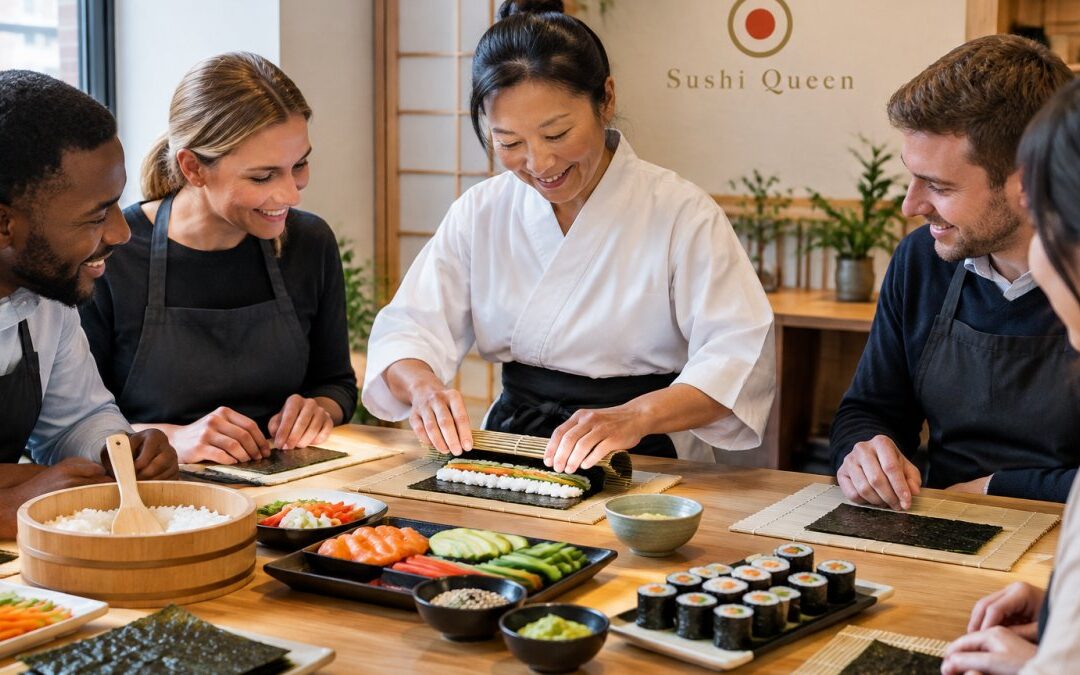
At Sushi Queen, we offer corporate sushi class for team building events. Book a corporate sushi team-building event once your date and headcount are set.
Step 2: Choose a Sushi Team-Building Activity That Fits Your Group
Pick the format that matches your group’s size, energy and comfort with raw fish, so everyone can take part in the sushi team-building activity.
- Hands-on workshop: best for small to mid teams who want to get messy
- Guided demonstration: good for large groups or mixed ability
- Japanese cooking class: suits teams who want more than sushi alone
To compare formats, explore the group sushi and Japanese cooking classes.
Step 3: Sort the Office Sushi Workshop Logistics and Dietary Needs
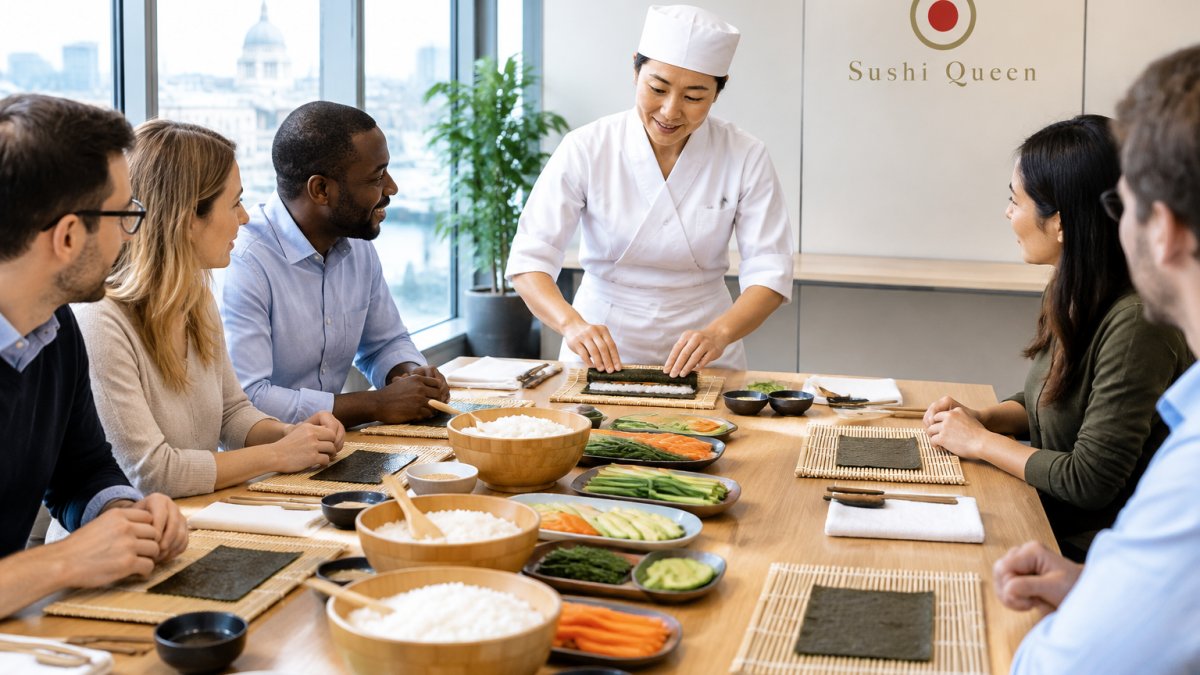
Logistics make or break an office sushi workshop. Sort the room, timing and food-safety details before the day.
Workspace and equipment. A hands-on rolling session needs one long table per group of roughly six to eight people, with elbow room for each person to roll. Confirm whether the provider brings bamboo mats, knives, boards, bowls and nori, or whether the office must supply any. Proper preparation of the workspace ensures that the team remains focused on the craft, just as having a clear plan to order group drinks helps maintain the social flow once the meal is served.
- A clear demonstration area at the head of the room
- Access to a sink for handwashing before and during the session
- Chilled storage for raw fish and other perishables
- Power sockets if the provider uses rice cookers, warmers or induction hobs
- Bins and a plan for waste, including food waste and packaging
- Table coverings or a wipe-clean surface, because rice and nori will end up on the floor
What the office provides versus what the instructor brings. Ask for this in writing. If your meeting room has no sink nearby, agree a handwashing plan in advance.
Dietary and allergy planning. Collect requirements at the point of RSVP, not the week before. Ask specifically about fish and shellfish allergies, gluten, sesame, soy, nuts, vegetarian and vegan diets, and pregnancy, because raw fish is often avoided during pregnancy. Ask how cross-contact is prevented between raw fish, shellfish and vegetarian items, and what alternatives are available for anyone who does not eat raw fish.
Food safety. Under UK food-safety rules, anyone handling or preparing food for others must follow hygiene guidance from the Food Standards Agency. Confirm your provider’s approach to chilled storage, clean surfaces, handwashing and the time raw fish is out of refrigeration. If your office kitchen is used for setup, check that it is clean and that the fridge is at the right temperature before the session.
Timing. Build a setup and clear-down window into your room booking.
Accessibility. Ask your provider about accessible work surfaces for wheelchair users.
| Logistics item | What to confirm | Why it matters |
|---|---|---|
| Room setup | Table space per group, chairs, demonstration area, power | Chef needs room to demonstrate and every attendee needs space to roll |
| Handwashing | Sink access or agreed alternative | Food hygiene before and during the session |
| Chilled storage | Fridge space for raw fish and perishables | Keeps food safe between setup and service |
| Dietary needs | Allergies, vegetarian, vegan, pregnancy, shellfish | Prevents cross-contact and ensures everyone can take part |
| Equipment | What provider supplies versus what the office provides | Avoids last-minute gaps |
| Waste | Bins and food-waste route | Keeps the room usable afterwards |
| Timing | Session length, setup, clear-down | Keeps the day on schedule |
If anything is unclear, contact the team to confirm dates, group size and dietary arrangements. Checking the Japanese cooking class menus in advance also helps you match dishes to your group’s requirements.
Step 4: Run the Sushi-Making Class for Groups and Measure the Result
Run the day like a well-paced event, then capture what worked. A sushi-making class for groups lands best when the chef leads and you handle the room.
Confirm final headcount, dietary requirements and the room booking. Send attendees a short note on what to expect, what to wear (avoid loose sleeves and open-toed shoes) and whether to bring anything.
Reconfirm the room layout, table plan and sink access before the session.
On the day. Allow time for setup before the first attendee arrives, and agree a clear-down plan with the venue.
Measuring outcomes. A show of hands is not a measurement. Send a short feedback form the same day with three or four questions: how likely they are to recommend the session, what they learned, and whether they would join another team event. Track attendance against invites and note how many people rolled rather than watched. If the goal was team bonding, ask whether they spoke to someone new. Compare results with your original goal from Step 1.
Post-event follow-up. If the session worked, book a follow-up date while feedback is fresh, providers’ best dates fill quickly. If not, note what to change: format, timing or room.
Many teams find the shared learning and social atmosphere do more for bonding than a formal away day. For a smooth run, follow this step-by-step guide to hosting a sushi party.
Frequently Asked Questions
How long should a corporate sushi-making class last?
Ask your provider to confirm the session length and running order in advance, so you can book the room accordingly. Ask your provider to confirm the running order in advance so you can book the room and send accurate calendar invites to your team.
Can you accommodate dietary requirements at a sushi workshop?
Yes, but you must confirm the details with your provider before the event. Collect allergies and dietary needs when people RSVP, then share them in writing at least a week ahead. Ask how the provider separates preparation areas and utensils, so you can answer questions from your team.
How many people can take part in a sushi-making workshop?
Group sizes vary by provider and venue. Small teams of 8 to 12 often work at one long table with a single chef. Larger groups of 20 to 50 usually need multiple stations and additional chefs to keep everyone hands-on rather than watching. When you request a quote, state your expected headcount and ask how many participants each chef can support. That number tells you whether the session will feel interactive or like a demonstration.
Planning a sushi making class for office teams comes down to early booking, the right format and airtight logistics. At Sushi Queen, our corporate sushi catering brings a Nagasaki-born chef’s technique to your office, with hands-on guidance, bespoke menus and dietary care built in. Get started with Sushi Queen and give your team a session they will actually remember.
