
Last Updated: October 30, 2026
Quick Summary
Real wasabi is often not what you get in sushi restaurants: many serve horseradish dyed green instead. Real wasabi is the freshly grated stem of Wasabia japonica, which is expensive and fades within about fifteen minutes, so premium restaurants grate it to order while casual counters use imitation.
- Imitation wasabi is made mainly from horseradish, mustard powder, starch, and green colouring.
- Genuine wasabi takes roughly two years or more to reach a harvestable size.
- Real wasabi heat blooms in the nose and fades within seconds.
- Imitation wasabi is a vivid, uniform green paste with a flat, lingering burn.
- Ask directly, since restaurants grating fresh wasabi are usually proud to say so.
Table of Contents
- Is Real Wasabi Used in Sushi? What Diners Actually Get
- Why the Green Paste Is Usually Imitation
- Why Is Wasabi Served With Sushi?
- Real Wasabi vs Imitation Wasabi: What Sets Them Apart
- What Is Imitation Wasabi Made Of?
- How to Tell If Wasabi Is Real
- Booking Authentic Sushi Catering for Your Event
- Frequently Asked Questions
Is Real Wasabi Used in Sushi? What Diners Actually Get
Here is the uncomfortable truth most sushi menus avoid: the green paste beside your nigiri is often not real wasabi. In many restaurants, the dollop is horseradish dyed green. This guide explains what is on your plate, why it is there, and how to spot the genuine article.
Real wasabi is the freshly grated stem of Wasabia japonica, a slow-growing plant in the same family as horseradish and mustard. It is expensive, perishable once grated, and subtly sweet rather than brutally hot. That combination of cost and fragility is the whole story behind the imitation trade.
Below, we break down what restaurants actually serve, why the pairing exists, and how you can tell the difference before you eat.
Why the Green Paste Is Usually Imitation
Whether a sushi restaurant serves real wasabi depends on its style, price point, and sourcing. Casual counters commonly serve imitation wasabi, while some premium restaurants grate fresh wasabi root to order.
The economics explain the pattern. Genuine wasabi is the grated stem of Wasabia japonica, a plant that needs clean, running water, shade, and cool conditions. It takes roughly two years or more to reach a harvestable size, and the usable stem is a small part of the plant. Once grated, the volatile compounds that create its aroma begin to fade within about fifteen minutes, so a busy service cannot grate ahead of time without losing the very quality diners are paying for.
Imitation wasabi solves those problems. It is made mainly from horseradish, mustard powder, starch, and green colouring, and it is cheap, shelf-stable, and consistent. That is why the vivid green paste is the default in most restaurants: it delivers heat at a fraction of the cost and without the perishability of the real root.
If you want to know what you are being served, ask directly. A restaurant that grates fresh wasabi will usually be proud to say so, and may show you the root or the grater.
That is not a scandal. It is supply and demand meeting a perishable luxury ingredient. But it does mean that a blanket claim that ‘sushi restaurants use real wasabi’ is misleading in both directions. Practices vary, and the most useful thing a diner can do is recognise the signs and ask.
Why Is Wasabi Served With Sushi?
The pairing is practical before it is ceremonial. Wasabi brings two things to raw fish: aroma and a sharp lift that cuts through the richness of oily fish such as mackerel or tuna belly. A small amount between fish and rice sharpens the flavour without masking it. Readers intrigued by the wasabi-sushi pairing can book a sake tasting with sushi workshop to experience it properly.
Traditional Japanese cuisine also treats wasabi as a palate cleanser between pieces. The pungency fades quickly, resetting your mouth so the next bite tastes fresh.
Real Wasabi vs Imitation Wasabi: What Sets Them Apart
The difference is not just heat, it is character. Real wasabi tastes of something; imitation tastes of a chemical idea of heat.
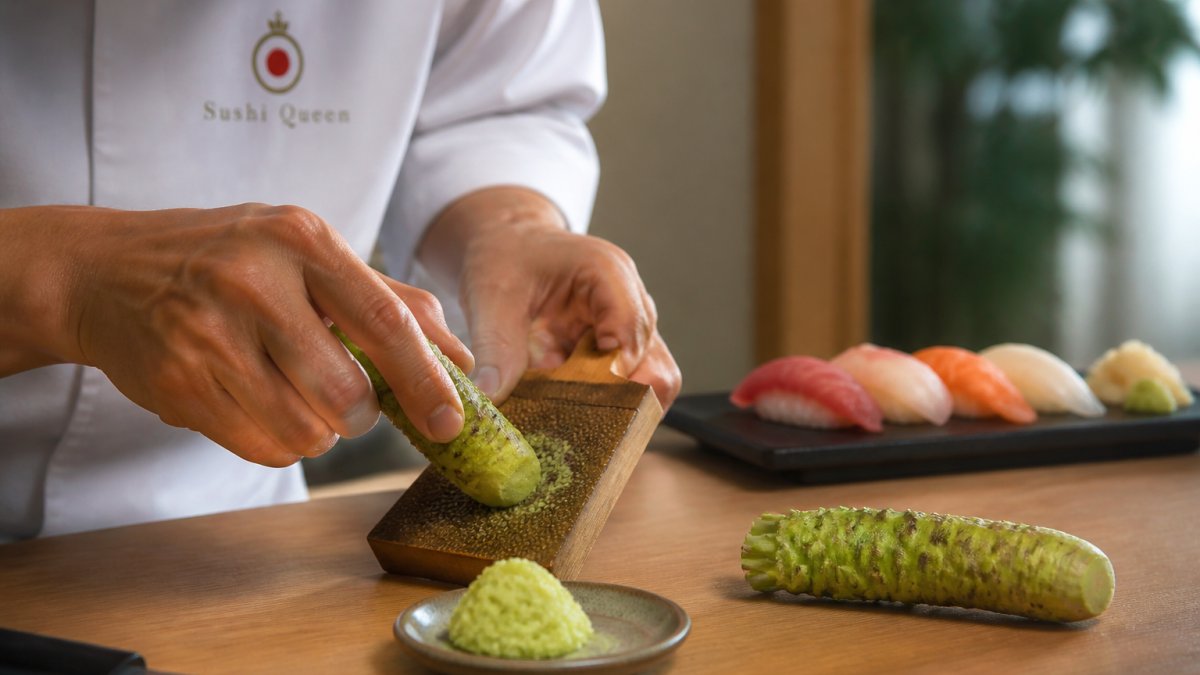
Freshly grated wasabi root has a pale green, almost sage colour and a damp, granular texture. Its heat blooms in the nose and then vanishes. Imitation wasabi is a uniform, vivid green paste with a flat, lingering burn.
Flavour, Heat and Aroma Compared
- Real wasabi: sweet, grassy, faintly floral; heat arrives and departs within seconds
- Imitation wasabi: sharp, one-dimensional heat that sits on the tongue
- Real wasabi: fades fast because the volatile compounds are unstable
- Imitation wasabi: consistent because it is built from stable ingredients
A common mistake is assuming stronger equals better. Readers learning wasabi etiquette can check out these sushi etiquette tips to eat correctly. With wasabi, the opposite is closer to the truth. (Source: the UK’s Food Information Regulations 2014)
What Is Imitation Wasabi Made Of?
Imitation wasabi is typically horseradish, mustard powder, starch, and green food colouring, bound with water or oil. Some versions add a little real wasabi for authenticity on the label, but rarely enough to change the taste.
Horseradish provides the heat because it is cheap and abundant. Mustard sharpens it. The colouring does the rest of the illusion.
None of this is harmful. It is simply a different product wearing the same name.
How to Tell If Wasabi Is Real
A practical identification guide is the fastest way to answer the question for yourself. Real wasabi and imitation wasabi differ in ingredients, appearance, texture, aroma, and how the heat behaves over time. The table below sets out the main contrasts.
| Feature | Real wasabi | Imitation wasabi |
|---|---|---|
| Main ingredients | Grated Wasabia japonica stem | Horseradish, mustard powder, starch, green colouring |
| Colour | Pale sage green, slightly uneven | Vivid, uniform green |
| Texture | Damp, slightly granular | Smooth, glossy paste |
| Aroma | Fresh, grassy, faintly floral | Sharp, pungent, one-dimensional |
| Heat | Blooms in the nose, fades within seconds | Flat burn that lingers on the tongue |
| Presentation | Grated to order, or a fresh stem with a grater | Tube, sachet, or pre-mixed paste |
The most reliable single check is how the heat behaves. Real wasabi contains volatile compounds that dissipate quickly once exposed to air, so the sensation arrives and departs within seconds. Imitation wasabi is built from more stable ingredients, so the burn sits on the tongue and lasts longer. A common mistake is assuming stronger equals better; with wasabi, the opposite is closer to the truth.
A second check is texture. Freshly grated real wasabi is damp and slightly granular, not glossy and uniform. A third is colour: real wasabi is a muted sage green, while imitation is usually a bright, even green that looks manufactured.
If you are served a smooth paste from a tube or sachet, it is imitation. If a chef grates a stem in front of you, or brings a fresh root and a small grater to the table, you are almost certainly getting the real thing. Readers curious about authentic wasabi and sushi craft can book a private fine master sushi sashimi class to learn hands-on. Asking is always reasonable, and a restaurant that uses fresh wasabi will usually be glad to explain.
Some menus describe a product as ‘wasabi’ even when it contains only a small proportion of real wasabi. The label is not a reliable guide; the texture, colour, and heat behaviour are.
Booking Authentic Sushi Catering for Your Event
If you have read this far, you likely want the real thing rather than the green stand-in. Private dinners and corporate functions are among the events we cater for.
We bring a mobile sushi bar and chefs to your venue. For corporate events, our corporate sushi catering can be arranged around your requirements.
Ready to ask about dates or a quote? Get in touch with Sushi Queen and we will walk you through what your event needs.
Frequently Asked Questions
Is real wasabi commonly used in sushi restaurants?
Rarely. Most high-street sushi outlets serve imitation wasabi made from horseradish, mustard powder and green food colouring. Real wasabi comes from the Wasabia japonica plant, which needs cool, running water and takes two years to mature, so it is costly and short-lived once grated. You are most likely to find freshly grated real wasabi at specialist or high-end Japanese restaurants, often grated to order and served alongside sashimi.
What is imitation wasabi made from?
Imitation wasabi is typically a blend of horseradish, mustard powder, cornstarch or potato starch, green food colouring and sometimes vegetable oil or water. It delivers a sharp, hot punch but lacks the sweet, aromatic finish of the real root. Checking the ingredient list on a tube or sachet is the quickest way to confirm what you are eating, because genuine wasabi paste lists wasabi itself near the top.
How can you tell if wasabi is real?
Real wasabi is grated to order and has a pale green, slightly textured appearance, with a sweet, grassy aroma and heat that fades within seconds. Imitation wasabi is a brighter, uniform green, smells sharp and mustardy, and the burn lingers. If it arrives as a smooth blob from a tube, it is almost certainly imitation. Ask the chef whether the root is grated fresh, which is the clearest sign of real wasabi.
Does real wasabi taste different from imitation wasabi?
Yes, noticeably. Freshly grated real wasabi has a subtle sweetness and a vegetal, almost pea-like flavour, with heat that hits briefly and then fades, letting the fish flavour come through. Imitation wasabi is harsher and more one-dimensional, with a mustard-like burn that overwhelms delicate fish. This is why chefs pair real wasabi with premium sashimi and nigiri, where the aim is to enhance umami rather than mask it.
The gap between real and imitation wasabi is small on a plate and large in experience. If you want your guests to taste the difference, Sushi Queen brings authentic Japanese catering, expert-led sushi classes, and a private chef service to events across the city. Get started with Sushi Queen and give your next celebration a genuinely authentic centrepiece.
